BlockForge
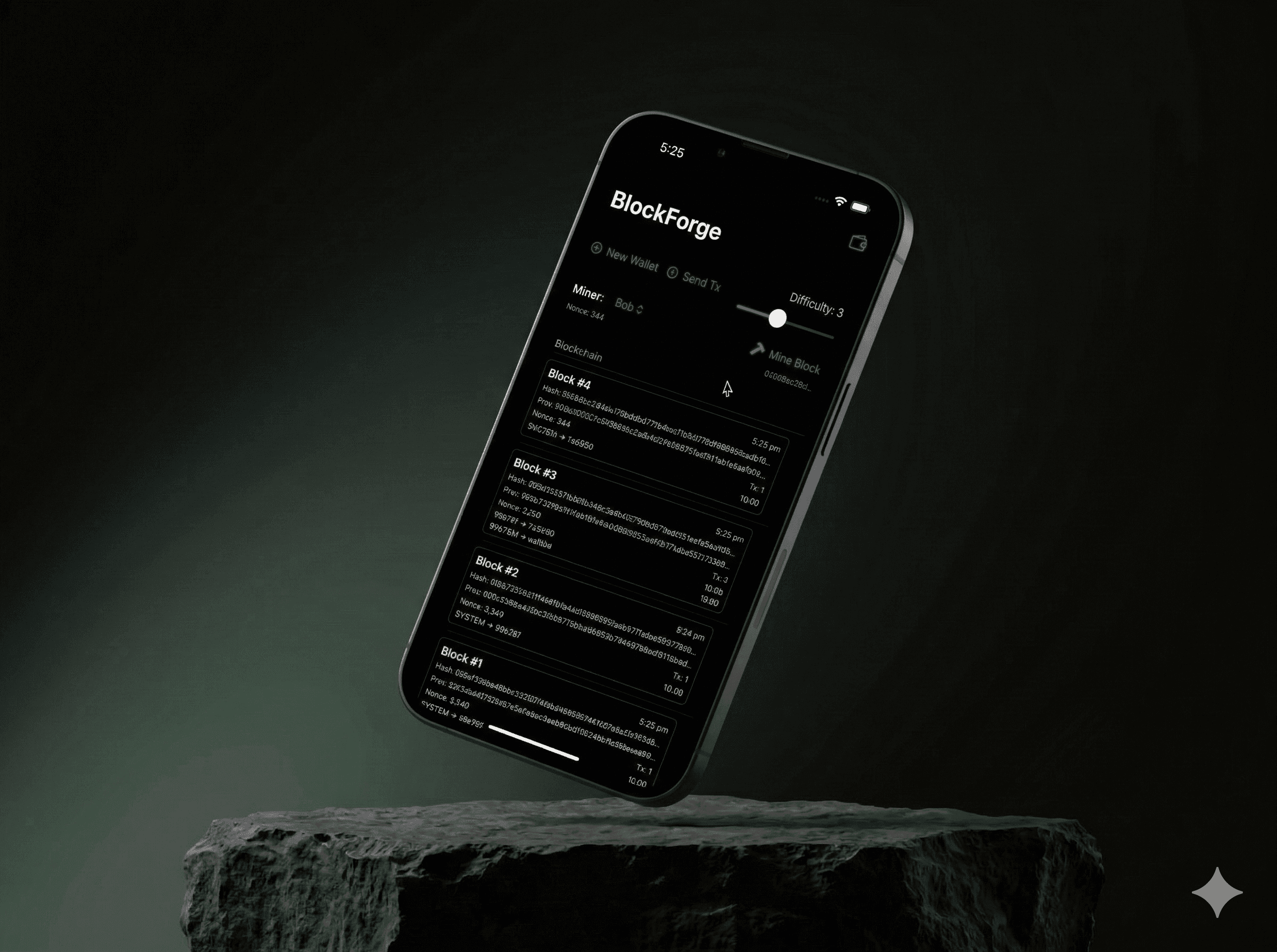
Simulates the complete lifecycle of a blockchain system, allowing users to create wallets, perform transactions, mine blocks using proof-of-work, and visualize the blockchain ledger in real time.
00
problem
Blockchain technology has rapidly become one of the most discussed innovations in modern computing, yet understanding its internal mechanisms remains difficult for most learners and developers. Concepts such as distributed ledgers, proof-of-work mining, cryptographic hashing, and transaction validation are often explained through theory rather than practical experimentation. As a result, many people understand the terminology but struggle to visualize how a blockchain actually functions under the hood.
solution
BlockForge was developed as an interactive blockchain simulator designed specifically for learning and experimentation. The application allows users to create multiple wallets, each with unique addresses used for sending and receiving transactions. Transactions between wallets are processed through a simulated blockchain environment where they are collected into blocks before being validated.
The inspiration for BlockForge emerged from the challenge of learning blockchain technology through traditional educational resources. While blockchain is frequently described as a revolutionary system for decentralized trust, its internal mechanics are often presented in ways that remain abstract for learners. Terms such as hashing, mining, proof-of-work, and distributed ledgers appear frequently in discussions about blockchain, yet the actual processes behind these concepts are rarely experienced directly. Most explanations rely on diagrams or theoretical descriptions that fail to convey the dynamic computational nature of the system.
The project began with the development of a simplified blockchain engine capable of handling wallet creation, transaction processing, and block generation. Each wallet was assigned a unique address, enabling transactions between different participants in the system. These transactions were collected into blocks that would later be mined using a proof-of-work algorithm.
Mining was implemented as a computational process that repeatedly generates hashes while adjusting a nonce value until a valid hash satisfying the difficulty requirement is discovered. Once a valid block is mined, it becomes part of the blockchain and is cryptographically linked to the previous block through its hash.
To make these processes visible and intuitive, the application was designed using SwiftUI with a strong emphasis on visual clarity. The blockchain ledger can be inspected directly, allowing users to see how blocks are connected through hashes and how transaction data is embedded within each block.
Another important aspect of the system is the adjustable difficulty setting. By increasing or decreasing mining difficulty, users can observe how the complexity of the proof-of-work puzzle influences the time required to mine a block. This feature highlights the computational trade-offs involved in maintaining security and consensus within blockchain networks.
year
July 2025
timeframe
26 days
tools
SwiftUI, Xcode, iOS
category
Personal Project